
If you have a red, scaly, itchy patch and you are not sure whether it is psoriasis or eczema, you are in very good company — and not just because the two look alike. They are confused so often that many people spend years with the wrong label. In one large UK primary-care study, people who were eventually diagnosed with psoriasis were twice as likely to have been diagnosed with eczema in the year before, and the correct diagnosis was missed or delayed for up to five years for some of them (primary-care study, 2022).
Spend ten minutes on r/Psoriasis and you will read the same story on repeat: told it was eczema, handed one cortisone cream after another, no real improvement, until someone finally looked closer. One person described being misdiagnosed for six years; others say multiple dermatologists called it eczema for most of their lives.
So this guide is not about playing doctor — only a clinician can diagnose you. It is about knowing what actually separates the two, so you can ask the right questions and get to the right answer faster.
The fastest way to tell them apart
Four things do most of the work: how the patch looks, where it is, how much it itches, and when it started. Here is the side-by-side.
| Psoriasis | Eczema (atopic dermatitis) | |
|---|---|---|
| Look | Thick, raised plaques with silvery-white scale | Red, inflamed, sometimes weepy or crusty; can look leathery |
| Edges | Sharp, well-defined borders | Fuzzy, ill-defined borders |
| Where | Outsides of elbows and knees, scalp, lower back, nails | Insides of elbows, behind knees, neck, wrists, face |
| Itch | Milder itch, but often burns or stings ("like fire ants") | Intense itch — "the itch that rashes," can bleed from scratching |
| Age it starts | Usually adulthood (often 15–35) | Usually childhood, often with asthma or hay fever |
| What drives it | Autoimmune — skin cells multiply too fast | Skin-barrier breakdown + hypersensitivity to triggers |
| Nails | Pitting, thickening, lifting off the nail bed | Ridges and thickening, but no pitting |
If you only remember one contrast: psoriasis is thick, silvery and sharply edged on the outside of joints; eczema is red, raw and fuzzy-edged in the bends of joints, and it itches like mad.
Look and texture
Psoriasis builds up. The immune system tells skin cells to grow on roughly a 3–4 day cycle instead of a month, so dead cells pile into raised plaques topped with that characteristic silvery scale. Pick at it and it can crack or bleed — dermatologists call those tiny bleeding points the Auspitz sign.
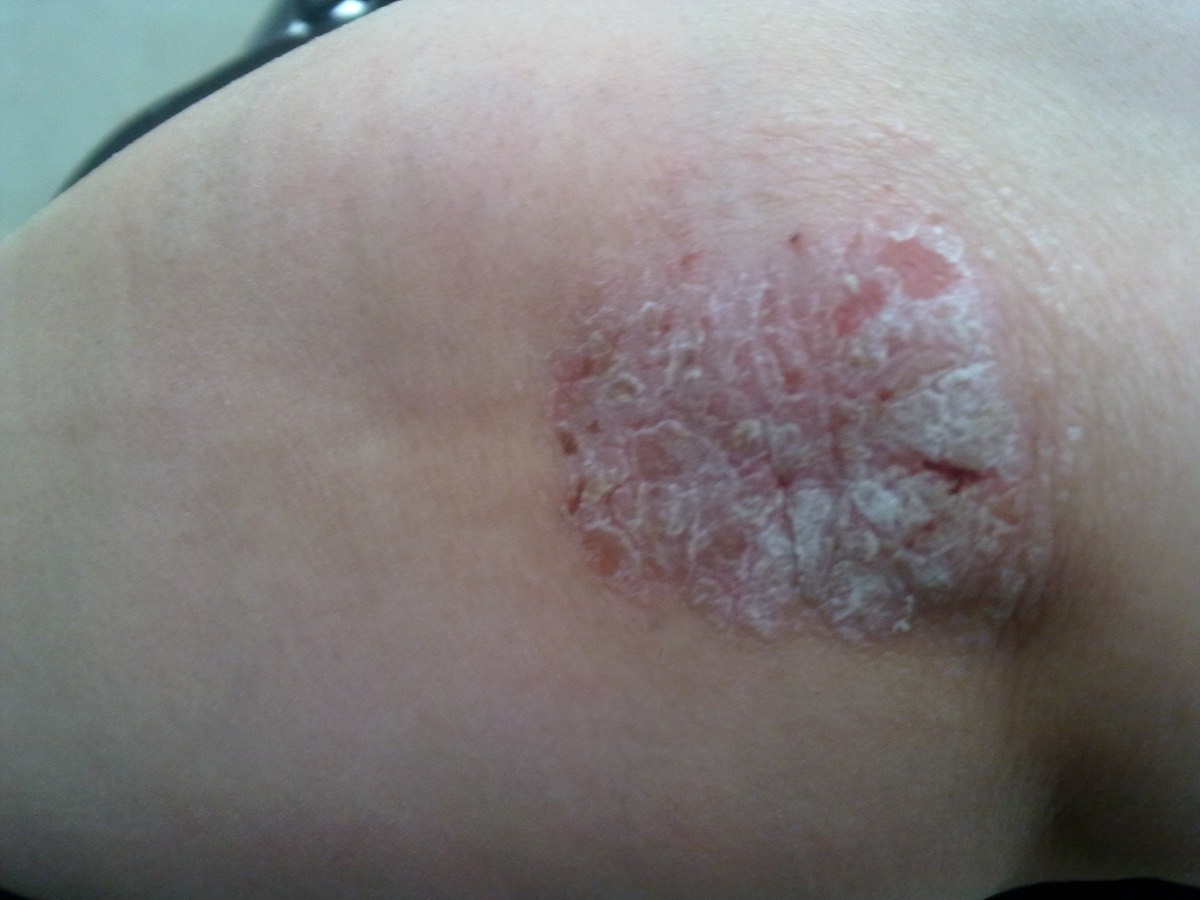
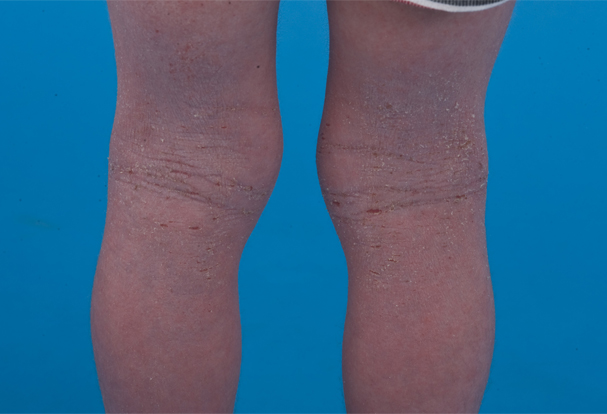
Eczema, by contrast, looks angry and wet rather than built-up. It is red and inflamed, often with tiny fluid-filled bumps that ooze and crust, and over time the skin can go leathery from scratching. The borders fade into normal skin instead of stopping at a clean line.
Location is one of the best clues
This one is genuinely useful because the two have almost opposite preferences:
- Eczema loves the bends — the inside of your elbows, the back of your knees, plus the neck, wrists, ankles and face.
- Psoriasis loves the outsides — the outer elbow and knee, the scalp and hairline, the lower back, palms and soles.
There are exceptions (inverse psoriasis hides in skin folds and looks far less scaly, which is part of why it gets mistaken for eczema or a fungal infection), but for most plaque psoriasis, location alone narrows it down fast.
Itch versus burn
Both itch, but differently. Eczema is famous for an itch so intense people scratch until they bleed — it is literally nicknamed "the itch that rashes." Psoriasis can itch too, but people more often describe burning, stinging or soreness, especially where plaques crack. If the dominant feeling is "I cannot stop scratching," that leans eczema; if it is "it stings and feels sore," that leans psoriasis.
When it started
Eczema usually shows up in childhood and travels with the "atopic triad" — asthma and hay fever often run alongside it. Psoriasis more often appears in your teens, twenties or later. Age is not proof, but a rash that first appeared in adulthood, with no childhood eczema history, tilts the odds toward psoriasis.
Why they get confused so often
A few reasons stack up:
- At a glance they overlap — both are red, scaly and itchy, and a quick look in a six-minute GP appointment is easy to get wrong.
- Steroid creams blur the picture. Topical corticosteroids are a first reflex for an itchy rash, and they calm both conditions enough to flatten the tell-tale scale — which can mask the signs of psoriasis and delay the real diagnosis (primary-care study, 2022). They are a legitimate treatment; they are just also good at hiding the evidence.
- You can occasionally have both, though it is uncommon — roughly 2% of people (National Eczema Association).
None of this is a knock on doctors — it is just a genuinely hard call from the outside. Which is exactly why what you bring to the appointment matters.
A quick self-check (not a diagnosis)
Run your patch through these. The more "psoriasis" answers, the more worth raising it specifically with your doctor:
- Is the scale thick and silvery, with a sharp edge? → psoriasis
- Is it on the outside of elbows/knees, scalp or lower back? → psoriasis
- Does it burn or sting more than it itches? → psoriasis
- Did it start in adulthood? → psoriasis
- Are your nails pitted (tiny dents)? → strongly psoriasis
- Is it in the bends of your joints and intensely itchy since childhood? → eczema
This will not replace an exam — a dermatologist confirms it by eye, sometimes with dermoscopy or a small skin biopsy. But it tells you which conversation to start.
What to do next
- See a dermatologist, not just a GP, if you can. Skin is their whole job, and the misdiagnosis numbers above come mostly from non-specialist settings.
- Don't start steroid cream the week before your appointment if you can avoid it — let the rash show its real face.
- Bring evidence. This is the single most useful thing you can do, and it is where most people fall short: skin changes day to day, and "it's been bad lately" is hard to act on. Photos of the same patch over a few weeks, plus notes on where it is, how it feels (itch vs burn) and what seems to set it off, turn a vague complaint into something a doctor can actually read.
That last point is exactly what MySkinly is for. You photograph your zones weekly and jot a quick daily note, and the app turns it into a clear timeline you can hand to your dermatologist — so the appointment starts from real data instead of memory. It works the same whether it turns out to be psoriasis, eczema, or something else entirely.
Image credits: Skincare photo — Shixart1985, CC BY 2.0. Plaque psoriasis on the elbow — Alborz Fallah, CC BY-SA 3.0. Eczema — NIAID, CC BY 2.0. All via Wikimedia Commons.
FAQ
Can a rash be both psoriasis and eczema?
Yes, but it is uncommon — around 2% of people have both. Far more often, one is being mistaken for the other. A dermatologist can tell them apart, and occasionally takes a small biopsy when the picture is unclear.
How do doctors tell psoriasis and eczema apart for sure?
Usually by examining the rash — its scale, borders and location — plus your history and family history. When it is genuinely unclear, a dermatologist may use dermoscopy or take a small skin biopsy: under the microscope, psoriasis shows thickened, compacted skin layers, while eczema looks spongy and swollen.
Why was my psoriasis diagnosed as eczema for so long?
It is extremely common. The two overlap at a glance, and steroid creams given for "eczema" can calm the rash enough to hide the scale that would point to psoriasis. Studies show the correct diagnosis is sometimes delayed for years — which is why it is worth raising psoriasis specifically, and seeing a dermatologist, if treatment is not working.
Is eczema or psoriasis more itchy?
Eczema is usually the itchier of the two — intensely so. Psoriasis tends to burn, sting or feel sore rather than itch, though it can do both. The type of discomfort is a useful clue on its own.